| The short answer | Restless legs tend to flare at night because activity winds down, dopamine signaling naturally dips in the evening, and any nutrient or lifestyle triggers you carry become easier to feel once you are still. |
| Common triggers | Low iron or magnesium, too much caffeine or alcohol, long sedentary days, some medications, and evening stress. |
| What helps | Gentle evening movement and stretching, warm baths, cutting back on caffeine and alcohol, steady nutrition, and a calming wind-down routine. |

You finally sit down after a long day, and your legs will not settle. There is an urge to move them, a crawling or fizzy sensation deep in the muscle, and a strange relief the moment you get up and walk — only for it to return the second you sit again. If that sounds familiar, you are asking a very common question: what causes restless legs at night, and what actually helps calm them?
Restless legs is a real, well-recognised pattern, and while its exact biology is still being studied, we know a lot about the everyday triggers that make it worse and the habits that make it better. This guide focuses on the practical, lifestyle side — the levers you can actually pull.
The hallmark of restless legs is timing: the urge to move is strongest in the evening and at rest, and eases with movement. A few things line up to make night the worst time.
The body runs on a roughly 24-hour clock, and the brain chemical dopamine — which helps control smooth, comfortable movement — naturally dips later in the day. That evening dip is thought to be part of why the sensation peaks after dark, and it is one of the features the National Institute of Neurological Disorders and Stroke uses to describe restless legs syndrome. Low iron stores are the other thread worth testing for, which is why the NIH iron fact sheet is a useful thing to read before changing anything.
Movement temporarily quiets the sensation, so all day, as you walk and fidget and work, you are unknowingly keeping it at bay. Lie down to relax or sleep and the mask is gone — which is exactly when the urge to move becomes impossible to ignore.
Caffeine from the afternoon, an evening glass of wine, a day spent mostly sitting, or an underlying nutrient gap can all quietly load the system. You feel the bill in the evening, when there is nothing else competing for your attention.

Everyone is different, but these come up again and again. Working through them one at a time is the most useful thing you can do:
Because restless legs sit at the crossroads of nerves and muscles, the nutrients that support both are worth getting right. Magnesium is central to relaxed nerve-to-muscle signaling. Iron matters for dopamine, though it should be guided by a blood test rather than guesswork. B-vitamins help maintain healthy nerve tissue, and calming botanicals such as passionflower, chamomile and the adaptogen schisandra berry have a long traditional history of supporting a settled, balanced feeling in the evening.

Food comes first here too: leafy greens, beans, nuts, seeds, lean red meat and fish deliver much of what your legs and nerves need. Where diet falls short, topping up the gaps is a reasonable strategy. Our broader guide on how to support nerve health naturally goes deeper on each nutrient.
Quiet Nerves is a once-daily capsule that names six ingredients: magnesium glycinate, alpha lipoic acid, butcher’s broom, L-carnitine, turmeric and coenzyme Q10. It contains no B vitamins or calming botanicals, the brand has not published the amounts, and every pack carries a 60-day guarantee from the purchase date.
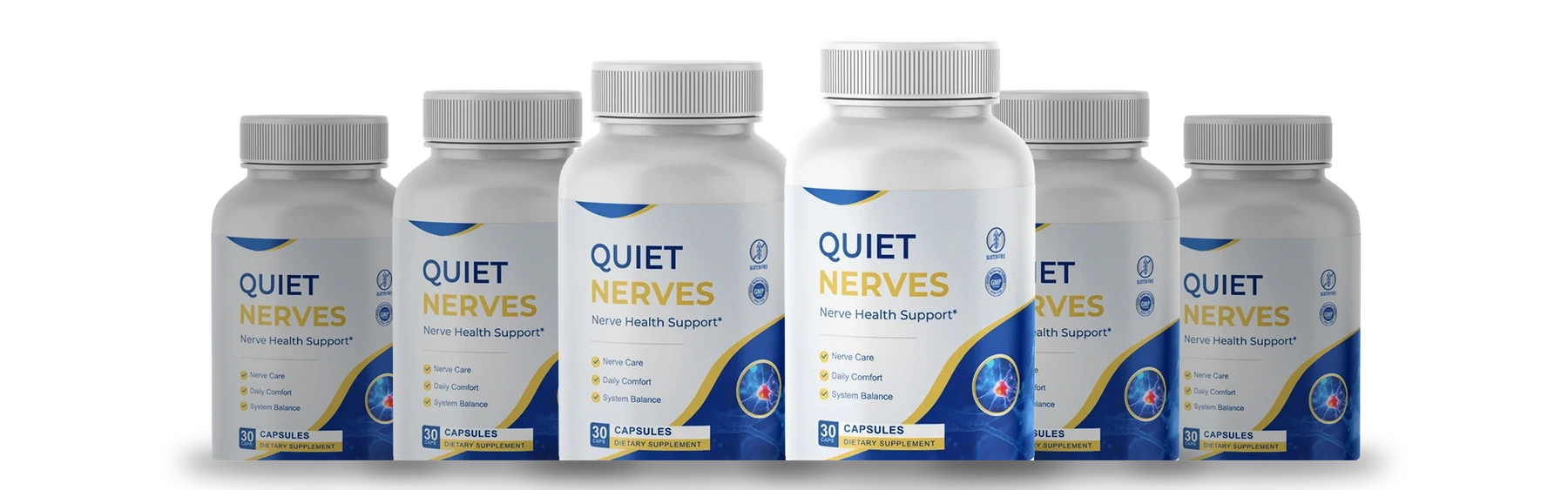 See Quiet Nerves Packages
Two neighbouring problems are worth ruling in or out before you change much else. The overlap between magnesium deficiency and muscle cramps means night cramps and restless legs are often described interchangeably even though they are not the same thing, and telling them apart changes what helps. The second is circular: restlessness costs you sleep, and because poor sleep makes nerve discomfort worse, a bad week can keep itself going long after whatever started it has gone.
The most effective plan is usually a stack of small, consistent habits rather than any single fix:

Lifestyle changes do the heavy lifting, and a well-formulated supplement can support them by helping keep the key nerve-and-muscle nutrients topped up day to day. The value of a single daily capsule such as Quiet Nerves is consistency — it is easier to stick with than several separate bottles. Give any nutrient routine several weeks, and remember that individual results vary.
Talk to a clinician if restless legs regularly wreck your sleep, are worsening, or come with other symptoms — and before you start iron supplements, so your levels can be tested first. Mention any medications you take, since some can make the sensation worse. Everyday support is not a substitute for a proper assessment, and this article is general information rather than medical advice.
The restless-legs urge to move follows a daily rhythm and is typically strongest in the evening and at rest. When you finally sit or lie down, there is nothing to mask the sensation, and the body’s natural dip in dopamine signaling later in the day can make the urge more noticeable. Triggers you carried through the day, such as caffeine, alcohol or a nutrient gap, also tend to surface once you are still.
Low iron is one of the most studied contributors to restless-legs sensations, and magnesium is involved in healthy nerve-and-muscle relaxation, so a shortfall can play a role for some people. It is worth asking a clinician to check your iron status before supplementing iron specifically. A food-first approach plus covering everyday nutrient gaps is a sensible general strategy.
For many people, yes. Caffeine is a stimulant that can amplify the urge to move, and alcohol, while it feels relaxing at first, disrupts sleep and depletes B-vitamins. Cutting back on both, especially in the afternoon and evening, is one of the simplest experiments to try.
Get up and walk, stretch the calves and hamstrings, do some ankle circles, or apply warmth with a bath or heat pad. Massaging the legs and distracting your mind with a calm activity can also help ride out an evening flare. Many people find a consistent wind-down routine reduces how often flares happen.
See a clinician if restless legs regularly disrupt your sleep, are getting worse, or come with other symptoms, and before starting iron supplements so your levels can be checked. Let them know about any medications you take, since some can aggravate the sensation. This article is general information, not a diagnosis or treatment plan.
† These statements have not been evaluated by the FDA. This product is not intended to diagnose, treat, cure or prevent any disease. It is general reading, not medical advice for your situation.
Text
Researched and written by the Quietnervese Editorial Team from the Quiet Nerves bottle, the brand’s own ingredient list and the agency and journal sources linked on the page.
Review
A second team member compares every figure and claim with its source before publication. No physician or pharmacist reviews these pages, so they are not medical advice.
Revision
. Found an error? Report it.
Have a doctor check any tingling, numbness or burning that has no known cause before you lean on a supplement; if weakness or numbness strikes one side of the body suddenly, call 911.
 Quiet Nerves