| The idea | Nerves are living tissue that rely on specific nutrients — support them from the inside, not just at the surface. |
| Key nutrients | Magnesium, B-vitamins (B6 & B12), plus antioxidants like alpha-lipoic acid and curcumin. |
| Everyday habits | Gentle movement, steady blood sugar, good sleep and less alcohol. |
If your hands tingle when you wake, your feet feel “buzzy” at the end of the day, or your legs won’t settle at night, you are far from alone. Everyday nerve discomfort becomes more common with age for a simple reason: the nervous system is high-maintenance tissue. It fires constantly, and to do that cleanly it needs a steady supply of specific minerals, vitamins and antioxidants.
Two things tend to happen together as we move past 50. Diets quietly narrow, so we take in fewer of the nutrients nerves depend on. At the same time, the body becomes less efficient at absorbing some of them — vitamin B12 is a classic example, because the stomach produces less of the acid needed to free it from food. The result is that the very nutrients that keep nerve signals crisp can run low right when they matter most.
The encouraging part: a nutrient-first, habits-first approach is squarely within your control. Below is how the pieces fit together.
Everyone’s experience is different, but a few sensations come up again and again when people start paying attention to nerve health. None of them are a diagnosis on their own — think of them as nudges to look at the fundamentals:
If these are mild and occasional, the everyday fundamentals below are a sensible place to start. If they are persistent, spreading or getting worse, skip ahead to the section on when to talk to a professional first.
Magnesium. This mineral is involved in hundreds of processes, including the healthy signaling between nerves and muscles, and the NIH magnesium fact sheet sets out how much adults need and who most often falls short. It also plays a role in that settled, relaxed feeling — which is why low magnesium so often shows up as restlessness and cramping. Leafy greens, nuts, seeds, beans and whole grains are all good sources.
B-vitamins, especially B6 and B12. The B-vitamins are workhorses for the nervous system. B12 in particular helps maintain the protective sheath around nerves, and a shortfall is a well-known contributor to tingling and numbness. Because absorption dips with age, B12 is one of the most common gaps in older adults.
Antioxidants — alpha-lipoic acid and curcumin. Nerves are vulnerable to oxidative stress, the everyday “wear and tear” of metabolism. Alpha-lipoic acid is an antioxidant that has been studied specifically for nerve comfort, while curcumin — the active compound in turmeric — is one of the most-researched plant antioxidants. Both are used to help defend nerve tissue against that ongoing stress.
Calming botanicals. Traditional herbs such as passionflower, chamomile and the adaptogen schisandra berry have long been used to support a calm, balanced feeling — a helpful complement when restlessness is part of the picture.
You can cover a surprising amount of ground at the dinner table. Aim for variety rather than perfection, and lean on these nerve-friendly staples through the week:
If your appetite is smaller than it used to be, or you simply do not eat a wide range of these foods, that is exactly the kind of gap a targeted supplement is designed to help close.
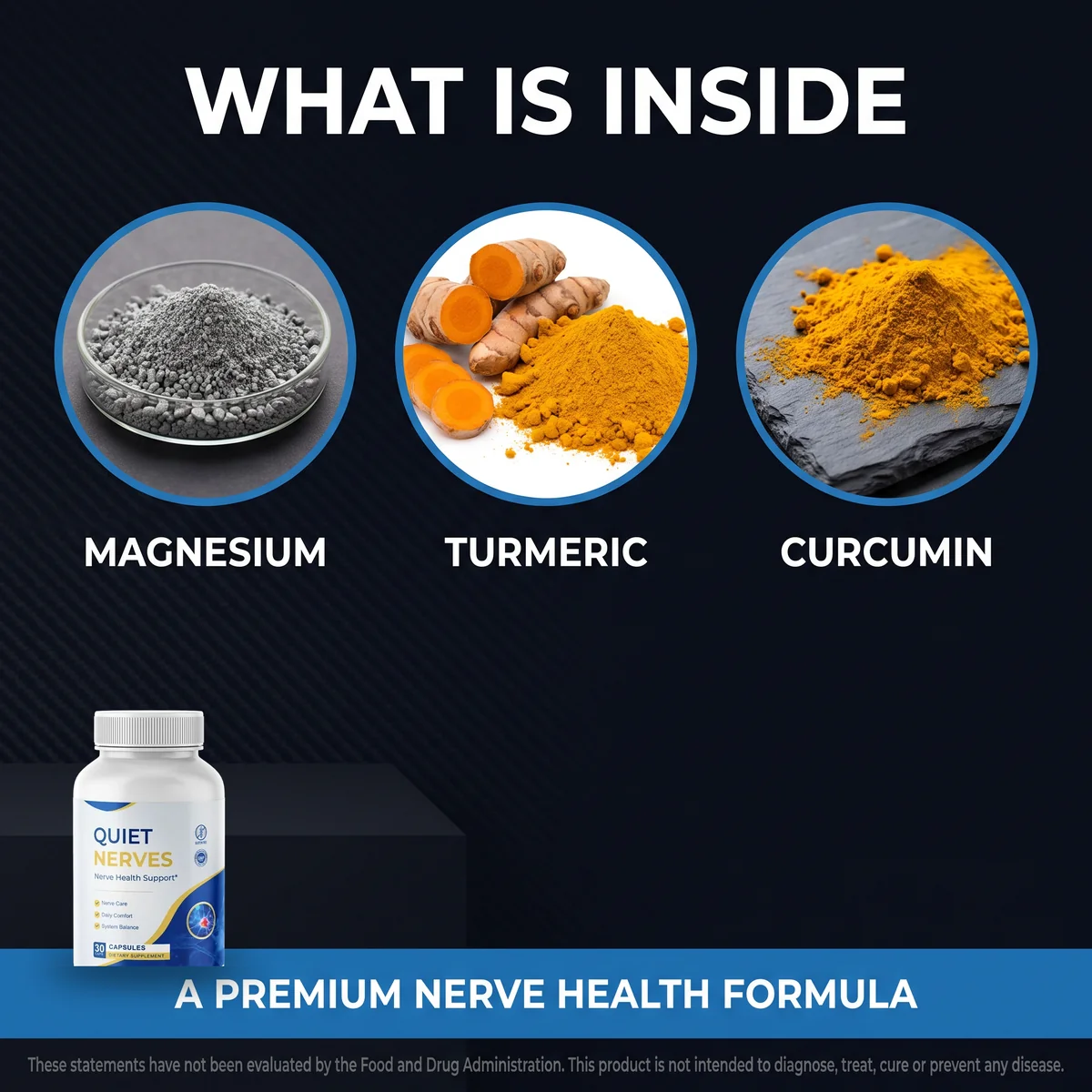
Quiet Nerves is a once-daily capsule that names six ingredients: magnesium glycinate, alpha lipoic acid, butcher’s broom, L-carnitine, turmeric and coenzyme Q10. It contains no B vitamins or calming botanicals, the brand has not published the amounts, and every pack carries a 60-day guarantee from the purchase date.
See Quiet Nerves PackagesIt is worth knowing what each of those nutrients looks like when it runs short, because the pattern differs. The relationship between magnesium deficiency and muscle cramps shows up as twitching, night cramps and restlessness, while B12 deficiency causes nerve tingling that is typically symmetrical, starts in the feet and creeps upward. Only one of those is confirmed by a blood test, and it is the one to ask about first. For the food side of it, our guide to the best foods for nerve health covers what to put on the plate before anything goes in a capsule.
Nutrients do their best work alongside a few simple habits — none of them dramatic, all of them additive:
Food first is always the right starting point. But if your diet has narrowed, or you simply want to make sure the key nutrients are covered day to day, a well-formulated nerve-health supplement can help fill the gaps. The value of a single daily capsule is consistency: it is far easier to keep up than a shelf of separate bottles. Quiet Nerves puts six named ingredients in one capsule, magnesium glycinate, alpha lipoic acid, butcher’s broom, L-carnitine, turmeric and coenzyme Q10, though no B vitamins or calming botanicals.
Whatever you choose, give it time. Nutrient support builds gradually, so most people give a consistent routine several weeks before deciding how they feel. And remember that everyone is different — individual results vary.
One habit deserves singling out, because it is the one most often traded away. Sleep is when the nervous system does its housekeeping, and short or broken nights lower the threshold at which discomfort registers — the reason poor sleep makes nerve pain and tingling worse is measurable rather than imagined. Protecting it costs nothing and tends to make every other change on this page work better.
Natural, everyday support is not a substitute for medical care. If your symptoms are new, worsening, one-sided, or paired with weakness, pain or loss of balance, see a clinician — these can be signs that deserve a proper assessment. The same goes if you are pregnant, nursing, under 18 or taking medication before starting any supplement.
Magnesium supports healthy nerve-to-muscle signaling, the B-vitamins (especially B6 and B12) help maintain nerve tissue, and antioxidants such as alpha-lipoic acid and curcumin help defend nerves against everyday oxidative stress. A food-first approach, topped up where needed, helps cover the gaps many diets leave after 50.
Yes. Regular gentle movement, steady blood-sugar habits, good sleep and limiting alcohol all support the nervous system. These habits work best together and alongside, not instead of, advice from your own clinician.
Nutrient support builds gradually rather than overnight. Most people give a consistent daily routine several weeks before judging how they feel, and everyone is different — individual results vary.
Support Your Nerves with Quiet Nerves
† These statements have not been evaluated by the FDA. This product is not intended to diagnose, treat, cure or prevent any disease. It is general reading, not medical advice for your situation.
Text
Researched and written by the Quietnervese Editorial Team from the Quiet Nerves bottle, the brand’s own ingredient list and the agency and journal sources linked on the page.
Review
A second team member compares every figure and claim with its source before publication. No physician or pharmacist reviews these pages, so they are not medical advice.
Revision
. Found an error? Report it.
Have a doctor check any tingling, numbness or burning that has no known cause before you lean on a supplement; if weakness or numbness strikes one side of the body suddenly, call 911.
 Quiet Nerves